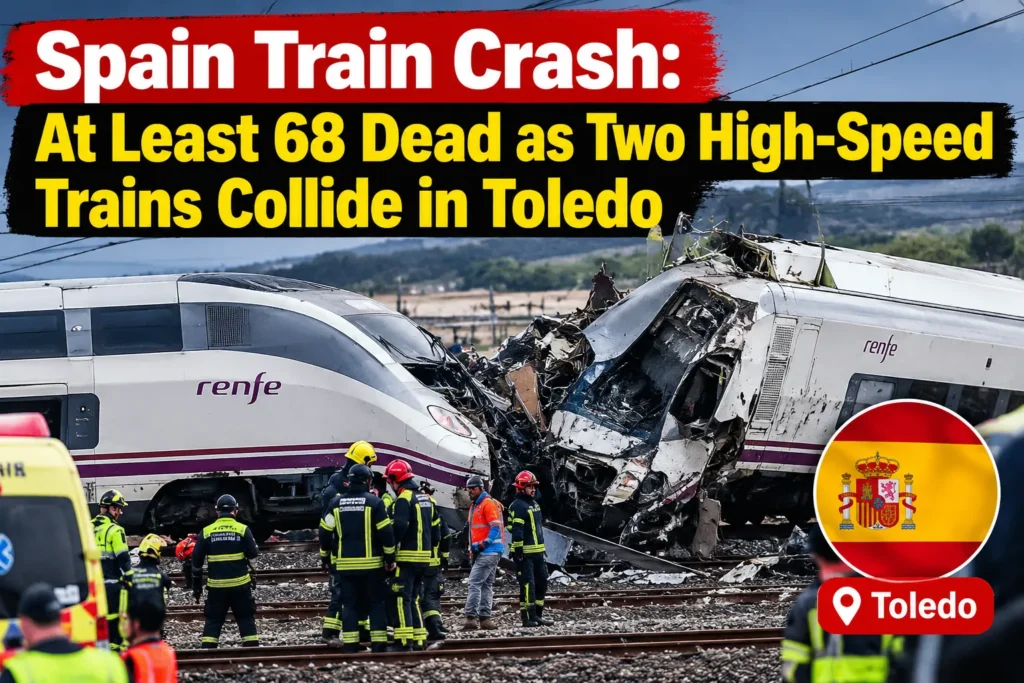

Spain Train Crash At least 68 people have been killed after two high-speed trains collided in central Spain, turning a routine journey into one of the country’s deadliest railway disasters in recent years. Rescue workers continued searching through twisted metal and damaged carriages on Wednesday, October 28, as authorities warned that the death toll could rise further.
The collision occurred in the province of Toledo, south of Madrid, involving trains operated by Spain’s state-owned Renfe and private rail company Iryo. Hundreds of passengers were travelling on the two services when the crash happened.
What Happened in the Spain Train Crash?
The accident occurred near the towns of Urda and Los Yébenes, along a high-speed railway route connecting Madrid with Spain’s southern region of Andalusia.
According to initial reports, a Renfe train struck the rear of an Iryo train that had stopped on the tracks. The impact damaged several carriages, with some derailing and falling down an embankment. Spain Train Crash
The force of the collision left wreckage scattered across the surrounding area. Emergency crews arrived to rescue trapped passengers, provide first aid and transport injured people to nearby hospitals.
Authorities confirmed at least 68 deaths, while dozens of others required medical treatment. Rescue teams faced a difficult operation as they worked through the most severely damaged sections of the trains.
Hundreds of Passengers Were on Board
The two trains were carrying a combined total of approximately 544 passengers, according to figures reported by Spanish authorities.
The Renfe service was carrying around 397 passengers, while the Iryo train had approximately 147 people on board. The large number of passengers made the emergency response especially challenging. Spain Train Crash
Survivors described a sudden impact that threw luggage and personal belongings around the carriages. Some passengers attempted to escape through windows while waiting for emergency services to reach them.
Local residents and workers in the area also rushed to help before professional rescue teams arrived. Their efforts highlighted the urgency of the situation as people tried to reach passengers trapped inside the wreckage.
Officials Investigate Possible Signalling Failure
Spanish authorities have begun investigating the circumstances that led to the collision. Early information has raised questions about the railway signalling system and the instructions given to trains after a technical malfunction.
Transport Minister Óscar Puente said a problem affecting the railway’s security system had disrupted operations on the line. According to his account, a train was subsequently authorised to move despite a stop signal remaining active.
Investigators will need to establish exactly what happened, why the train was allowed to proceed and whether communication or operational failures contributed to the crash.
Officials have not completed their investigation, and the precise sequence of events remains subject to further examination. Spain Train Crash
Rail Services Suspended as Spain Responds
Rail services between Madrid, Ciudad Real and Andalusia were suspended following the accident, disrupting journeys across a major transport corridor.
Emergency personnel, firefighters, police officers and medical teams were deployed to assist victims. Hospitals in the surrounding region received injured passengers, while local authorities arranged support for survivors and their families.
Spanish Prime Minister Pedro Sánchez expressed his sorrow over the disaster and said emergency services were working to help those affected. The country’s royal family also expressed condolences to victims and their loved ones.
The immediate priority remains caring for survivors, identifying those who died and providing accurate information to worried families.
A Second Deadly Railway Disaster in One Year
The tragedy has renewed concerns about railway safety in Spain, a country known for its extensive high-speed rail network.
In January 2026, another collision involving trains operated by Renfe and Iryo killed 46 people in southern Spain. That disaster raised questions about railway infrastructure, maintenance and operational safety.
Wednesday’s crash is likely to intensify those concerns. Investigators will face pressure to establish whether the latest collision resulted from human error, a technical failure or a combination of factors.
For the families waiting for news of missing relatives, however, the immediate concern is far more personal. As rescue teams continue their work, Spain faces another painful reminder of the devastating consequences of a railway accident.
FAQs
1. How many people died in the Spain train crash?
At least 68 people were reported killed in the collision between two high-speed trains in Toledo province on October 28, 2026. The death toll could change as authorities continue their work.
2. Where did the Spain train crash happen?
The collision occurred near Urda and Los Yébenes in Spain’s Toledo province, along a railway route connecting Madrid with Andalusia.
3. What caused the Spain train crash?
Authorities are investigating a possible signalling-system malfunction and the instructions given to a moving train. The exact cause has not yet been definitively established.



Pingback: Justin Tucker Returns to the NFL: Kansas City Chiefs Sign Former Ravens Star After Harrison Butker’s Struggles - GyanDe.Com