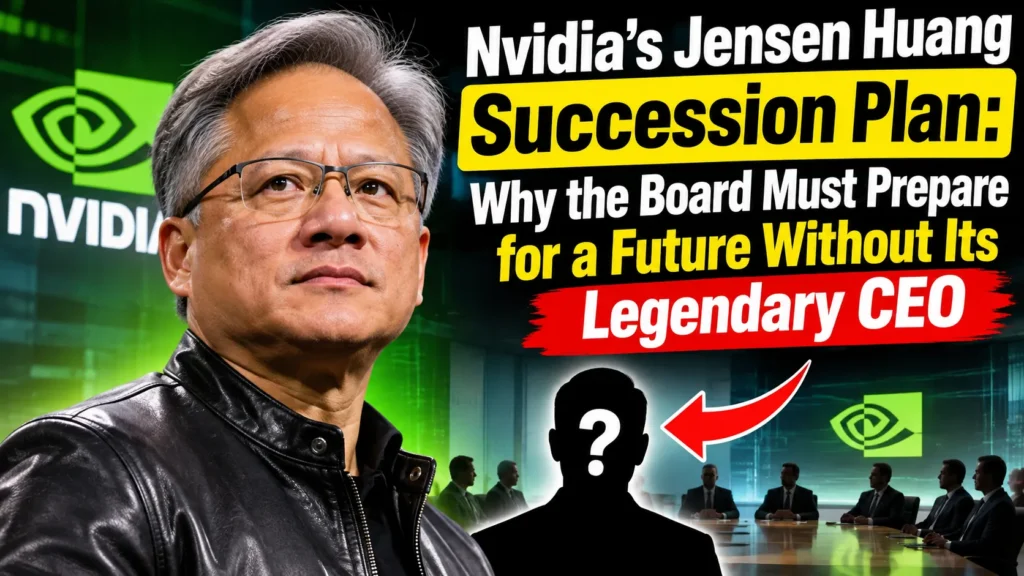

Nvidia’s Jensen Huang Nvidia has become one of the most important companies in the global technology industry, but its remarkable success has raised an uncomfortable question: What happens when Jensen Huang is no longer running the company? The chipmaker’s board now faces growing pressure to explain how it would handle a sudden leadership change and who could take charge if its longtime chief executive stepped aside.
The debate over the Nvidia succession plan has become more urgent as the company faces fresh governance questions and increased attention surrounding Huang’s leadership. Investors have benefited enormously from his decisions, but depending so heavily on one individual creates risks that cannot be ignored Nvidia’s Jensen Huang.
Nvidia’s Jensen Huang Has Become the Face of Nvidia
Huang co-founded Nvidia in 1993 and has led the company through several major transformations. What began as a graphics chip business eventually became a central force behind artificial intelligence, advanced computing and data center technology.
His leadership has played a major role in Nvidia’s rise. Huang has helped guide long-term investments in graphics processing units, the CUDA software platform and AI infrastructure Nvidia’s Jensen Huang.
However, this success has also made him difficult to separate from the company’s identity. Customers, investors and business partners often look directly to Huang for updates about Nvidia’s direction.
That concentration of influence makes the Nvidia succession plan an important issue for shareholders who want the business to remain stable beyond its founder’s leadership Nvidia’s Jensen Huang.
Why the Board Cannot Ignore Succession Planning
A CEO succession plan is not simply about choosing someone to replace an executive after retirement. It involves preparing multiple leaders, transferring important responsibilities and making sure the company can continue operating during an unexpected transition.
Nvidia has not publicly identified a designated successor to Huang. Its corporate filings also do not provide investors with a clear picture of who would take over the CEO position if he became unavailable.
That lack of public clarity raises questions about the board’s preparation. A company with Nvidia’s global importance cannot afford uncertainty at the top during a major business transition.
The board should explain how it evaluates leadership candidates and whether emergency arrangements are already in place Nvidia’s Jensen Huang.
Who Could Take Over If Huang Steps Aside?
Nvidia has experienced executives who understand different parts of its business. Chief Financial Officer Colette Kress is among the most recognizable leaders, with extensive experience managing the company’s financial operations.
Other senior executives include Nick Parker, who oversees worldwide field operations, Debora Shoquist, who leads operations, and Tim Teter, the company’s general counsel Nvidia’s Jensen Huang.
These executives bring different strengths, but Nvidia has not announced that any of them is the official successor.
The challenge is finding someone who can combine technical understanding, business strategy, customer relationships and the confidence of investors.
The Nvidia succession plan should also consider whether a single executive could handle the entire role or whether responsibilities would initially be shared among several leaders Nvidia’s Jensen Huang.
Recent Governance Questions Add Pressure
The succession debate has gained additional attention following Nvidia’s November 8, 2026, announcement that its independent directors would investigate reports involving Huang and a foreign intelligence effort.
The company said it had no reason to believe that national security or Nvidia secrets had been compromised. Huang also committed to cooperating with the review.
The announcement has placed greater attention on the board’s responsibility to protect the company and its shareholders Nvidia’s Jensen Huang.
This situation does not mean Huang is leaving his position. However, it demonstrates why the Nvidia succession plan should not depend entirely on the assumption that its founder will always remain available.
Investors Deserve a Clearer Picture
Nvidia is deeply connected to the global AI economy. Its chips power major data centers, research projects and AI services, making leadership stability important beyond the company’s own shareholders.
A stronger succession framework would help investors understand how Nvidia could manage an unexpected departure without disrupting its long-term strategy.
The board does not necessarily need to announce a future CEO immediately. It should, however, communicate that potential leaders are being developed and that a credible transition process exists. Nvidia’s Jensen Huang
Ultimately, the Nvidia succession plan is about protecting the company’s future, not questioning Huang’s achievements. His contribution to Nvidia is enormous, but no business should be built around the assumption that one person can lead it forever.
FAQs
1. Does Nvidia have a publicly announced succession plan?
Nvidia has not publicly named a designated successor to Jensen Huang or disclosed a detailed CEO succession arrangement.
2. Who could replace Jensen Huang as Nvidia CEO?
Colette Kress, Nick Parker, Debora Shoquist and Tim Teter are among Nvidia’s senior executives, but the company has not officially selected any of them as Huang’s successor.
3. Why is Jensen Huang’s succession important for investors?
Huang has played a central role in Nvidia’s strategy and growth. A clear leadership transition process would help protect investor confidence and reduce uncertainty if he eventually leaves the CEO position.



Pingback: ESPN and College Football Playoff Reveal 24-Team Expansion: New Format, Byes and Major Changes Explained - GyanDe.Com