
China’s AI Boom Takes a Dramatic Turn
AI Bubble is facing a painful reality check. After months of excitement around AI companies, semiconductor manufacturers and robotics startups, investors are now watching billions of dollars disappear from the market. The sudden reversal has raised serious questions about whether technology stocks became too expensive too quickly.
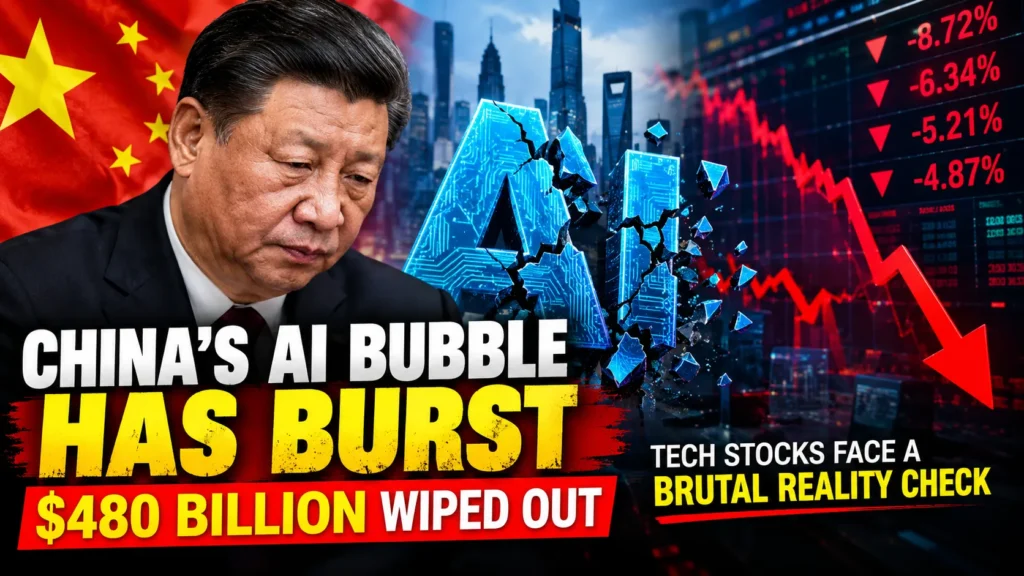
The country’s STAR50 index, which tracks major technology and semiconductor companies, has fallen around 40% in less than four months, wiping out approximately $480 billion in market value. China’s broader CSI300 blue-chip index has also dropped about 20% from its June peak. The decline marks a sharp change in sentiment after a two-year rally driven partly by government support and expectations surrounding artificial intelligence.
Why the AI Bubble Is Losing Its Momentum
The growing AI Bubble was built on expectations that artificial intelligence would transform industries and create enormous profits. Investors poured money into companies developing advanced chips, robotics systems and AI infrastructure, often pushing stock prices far beyond what their current earnings could justify.
However, the enthusiasm is now colliding with concerns about demand, profitability and expensive valuations. Some investors are questioning whether companies can generate enough revenue to support the prices their shares reached during the rally.
The STAR50 index has fallen from a valuation of nearly 250 times trailing earnings to around 100 times. Although prices have declined considerably, that valuation remains high compared with the Nasdaq 100, which has traded at approximately 30 times trailing earnings, according to the latest reporting.
Robotics and Chipmakers Feel the Pressure
Some of China’s most popular technology companies have suffered steep losses. Unitree, a prominent robotics manufacturer, has seen its shares fall by roughly half since beginning trading in August. Semiconductor companies have also struggled as investors reconsider the long-term value of businesses associated with the AI Bubble.
MetaX Integrated Circuits and Moore Threads Technology, which experienced enormous gains during their market debuts, have also lost around half their value since July. Meanwhile, optical-component manufacturers Zhongji Innolight and Eoptolink Technology have fallen approximately 60% from their respective peaks.
These declines show how quickly market excitement can disappear when investors become concerned about valuations. Companies connected to promising technologies are not automatically guaranteed to deliver strong financial returns.
Trade Restrictions Add Another Layer of Uncertainty
China’s technology industry also faces pressure from international trade restrictions. Concerns about possible US restrictions on Chinese equipment used in data centres have added uncertainty for manufacturers supplying components to the global AI industry.
These worries come at a difficult time for businesses investing heavily in research, production and infrastructure. If overseas demand weakens or companies lose access to important markets, their expected earnings could fall short of investor expectations.
The situation also raises questions about how easily Chinese technology companies can maintain growth while competing on price. Some market participants warn that semiconductor and AI suppliers could eventually face price wars, making it harder to protect profit margins.
What the Market Crash Means for Investors
The collapse has hit individual investors particularly hard. AI-related stocks had become a major force in China’s equity market, accounting for around 42% of market capitalisation and 57% of trading turnover across mainland-listed A-shares and Hong Kong-listed H-shares, according to Goldman Sachs figures cited in the reporting.
The downturn could make investors more cautious about funding new technology businesses, potentially slowing share offerings and fundraising. It also challenges Beijing’s efforts to encourage households to invest in equities and support a more stable stock market.
However, the correction does not necessarily mean artificial intelligence has lost its long-term potential. Some investors believe lower share prices could eventually create opportunities, provided company valuations become more reasonable.
FAQs About China’s AI Bubble
1. What is the AI Bubble in China?
The AI Bubble refers to concerns that investors pushed artificial intelligence-related stock prices beyond levels justified by companies’ earnings and realistic growth prospects.
2. How much money has China’s AI stock crash wiped out?
China’s STAR50 index has fallen around 40% in less than four months, erasing approximately $480 billion in market value.
3. Does the AI Bubble bursting mean AI technology will fail?
No. A stock market correction does not mean the technology itself has failed. It means investors are reassessing company valuations, future profits and the financial risks associated with AI investments.