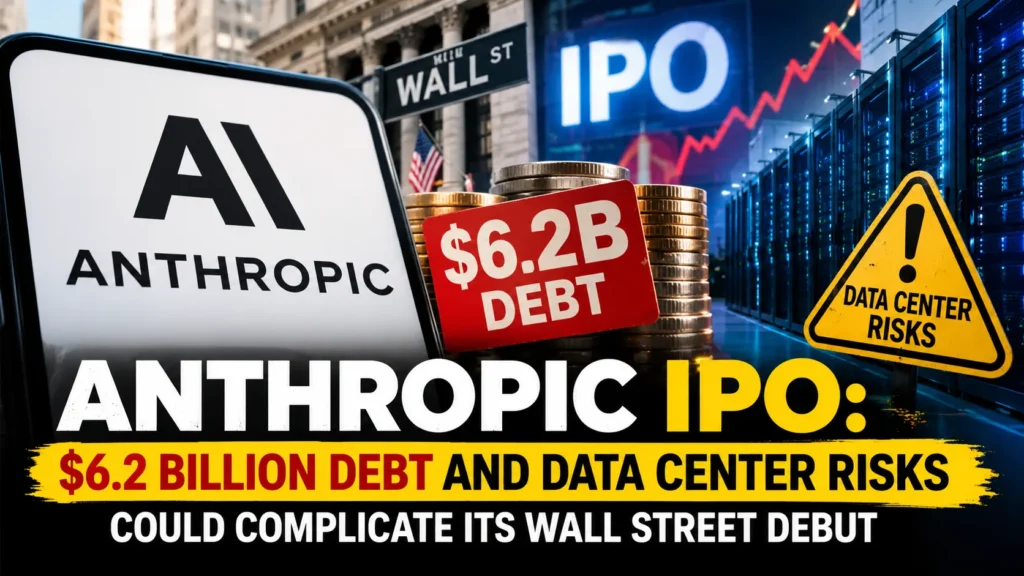

Anthropic IPO potential initial public offering (IPO) is drawing attention to a major question facing the artificial intelligence industry: how much money will it take to sustain the race for increasingly powerful AI systems? The company behind Claude has ambitious growth plans, but reported debt obligations of $6.2 billion and concerns about data center restrictions highlight the financial and infrastructure challenges that could shape its future.
For investors, the story goes beyond the popularity of AI chatbots. Anthropic IPO ability to fund its technology, secure computing capacity and manage rising operating costs could influence how the market values the company if it moves toward a public listing.
Anthropic’s IPO Plans Put Its Finances Under the Spotlight
An Anthropic IPO would give public-market investors an opportunity to buy shares in Anthropic and assess its business prospects. However, a potential listing also means greater scrutiny of the company’s financial commitments, spending plans and path toward sustainable revenue.
Anthropic IPO operates in a highly competitive market where developing advanced AI models requires significant investment in computing infrastructure, specialized chips and research talent. Even companies attracting substantial commercial interest must spend heavily to train and operate their systems.
The reported $6.2 billion in debt adds another consideration for investors. Understanding the nature of those obligations, their repayment schedules and how they relate to the company’s broader financing arrangements would be essential when evaluating its financial position.
What the $6.2 Billion Debt Means for Investors
Anthropic IPO filing identifies approximately $6.2 billion in outstanding convertible notes associated with Amazon. These notes are a form of financing that can potentially convert into company shares under specified conditions.
That distinction matters because convertible debt does not work exactly like a conventional bank loan. Its eventual impact depends on the agreement’s terms, including how conversion works and what happens when a company completes an IPO.
Amazon is also a major commercial partner, making its relationship with Anthropic IPO important to the company’s financial future. Investors will want to understand how financing arrangements, cloud services and infrastructure commitments interact as Anthropic prepares for public-market scrutiny.
Data Center Moratoriums Emerge as a Major Risk
Data center construction has become a critical issue for AI companies. Advanced models require enormous computing power, and that means access to electricity, land, cooling systems and specialized hardware can determine how quickly a business expands.
Anthropic IPO has warned about the potential impact of restrictions on new data center development. Moratoriums or tighter permitting rules could delay projects, limit available computing capacity and make infrastructure more expensive.
Local communities and policymakers are increasingly weighing the environmental and electricity demands of large computing facilities. If governments restrict construction in important locations, AI companies could struggle to secure the capacity they need to meet growing customer demand.
For Anthropic IPO, the challenge is particularly important because infrastructure investments often require long-term commitments. A delayed facility could create problems if the company has already agreed to pay for equipment, electricity-related services or computing capacity.
Revenue Growth Comes With Enormous Costs
Anthropic IPO business has expanded rapidly as companies adopt Claude and its AI-powered coding tools. Its IPO filing reported approximately $16.3 billion in revenue for the first half of 2026, highlighting the growing commercial demand for its technology.
However, the filing also reported a net loss of approximately $80.7 billion during the same period, largely driven by changes in the fair value of convertible securities rather than ordinary operating expenses alone. Investors will need to distinguish accounting effects from the underlying performance of the business.
Computing infrastructure remains one of Anthropic’s largest expenses. The company must balance customer growth against the cost of developing more capable models and maintaining reliable services.
That creates a difficult question for potential shareholders: can revenue continue rising quickly enough to support the company’s substantial financial commitments?
What Investors Should Watch Next
Anthropic’s proposed Nasdaq listing, under the ticker symbol ANT, could become a major test of investor confidence in the AI sector. The final offering price, valuation and number of shares available will help determine whether public-market buyers consider the opportunity attractive.
Investors should pay particular attention to:
- The final IPO valuation and share structure.
- Outstanding debt and long-term infrastructure commitments.
- The availability of electricity and computing capacity.
- Competition from OpenAI, Google and other AI developers.
- The company’s ability to turn rising revenue into sustainable financial performance.
The potential listing offers investors access to one of the industry’s leading AI developers, but rapid growth alone does not guarantee attractive returns. Anthropic’s financial commitments and infrastructure risks could prove just as important as its technology.
FAQs
1. Is Anthropic going public?
Anthropic publicly filed IPO paperwork in October 2026, outlining plans for a potential Nasdaq listing under the ticker symbol ANT. Final offering details remain subject to the IPO process.
2. Why does Anthropic have $6.2 billion in debt?
The reported amount relates to outstanding convertible notes associated with Amazon. These financing instruments may convert into company shares under specified conditions.
3. Why are data center moratoriums a risk for Anthropic?
Restrictions on data center construction could delay infrastructure projects, limit computing capacity and increase costs. These challenges could affect Anthropic’s ability to expand its AI services and meet customer demand.