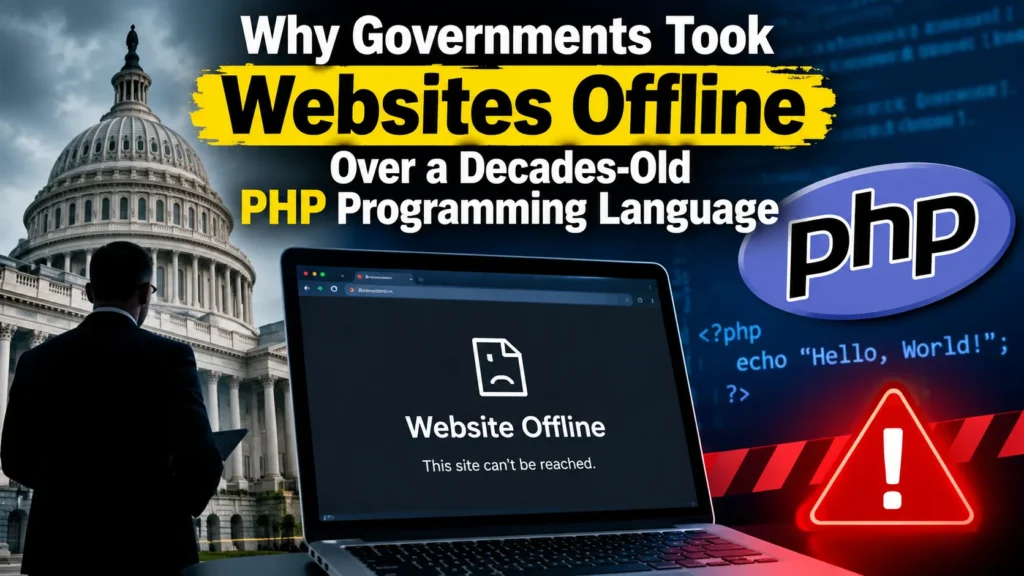

Governments shutting down websites over an old programming language sounds unusual, but the issue highlights a serious problem in digital security: software that continues running long after its safest days may have passed. PHP, one of the world’s most widely used web development languages, has powered websites for decades. Yet when older versions or vulnerable applications remain online, the consequences can reach far beyond developers and IT teams.
Why PHP Became a Government Security Concern
PHP first appeared in the 1990s and became a popular tool for building dynamic websites, from simple pages to complex content management systems. Its widespread adoption means that older PHP-based applications can still be found across public and private networks. The language itself is not inherently unsafe. The greater risk comes from outdated versions, unpatched vulnerabilities, poorly maintained code and insecure server configurations. Attackers can exploit these weaknesses to access sensitive information, alter web pages or compromise systems connected to a website. For government agencies, even a relatively small vulnerability can become a major concern when public services or confidential information are involved.
Why Taking a Website Offline Can Be Necessary
When security teams discover a serious vulnerability, they must decide whether a website can remain available while repairs are made. If the risk cannot be contained quickly, temporarily taking the service offline may be the safest option. A shutdown can prevent attackers from exploiting a known weakness while administrators investigate the problem, apply security updates and check whether unauthorized access has occurred. It can also protect other systems if the affected website shares infrastructure with government databases or internal services. However, not every website outage involving PHP proves that the language itself caused the problem. Establishing the reason requires details about the affected system, the vulnerability and the government’s official response.
The Real Problem With Outdated PHP Versions
PHP has evolved significantly since its early releases. Newer versions receive security improvements and performance updates, programming language, while older branches eventually reach the end of their official support periods. Once a version is no longer supported, newly discovered vulnerabilities may not receive official fixes for that release. Organizations that continue using it face increasing risks, particularly when their websites handle personal records, payments or sensitive public information. The challenge is not always obvious to visitors. A website may look modern while running on an outdated server environment behind the scenes. Its design can remain unchanged even when the technology underneath has become difficult to secure.
What a Government Website Shutdown Means for the Public
Taking a public website offline can disrupt access to essential information, online applications, public records and administrative services. For people who depend on digital government services, even a short interruption can cause frustration or delay important tasks. At the same time, keeping a vulnerable website online simply to avoid inconvenience can expose users to greater harm. A successful attack could compromise personal data, redirect visitors to malicious pages or undermine confidence in public institutions. The best response depends on the severity of the vulnerability. In some cases, programming language, administrators can isolate the affected component and continue operating other services. In more serious situations, a complete temporary shutdown may be justified.
How Organizations Can Prevent Similar Problems
Security specialists generally recommend keeping software supported, applying patches promptly and reviewing applications for weaknesses before attackers discover them. Government departments also need clear inventories of their websites, because an abandoned portal can remain exposed even when nobody actively maintains it. Important steps include: – Upgrading unsupported PHP versions to currently supported releases. – Installing security patches for PHP, web servers and related applications. – Running vulnerability assessments and monitoring suspicious activity. – Maintaining tested backups and an incident response plan. – Retiring unused websites and services instead of leaving them online indefinitely. These measures help reduce risk without requiring organizations to rebuild every website from scratch. programming language
FAQs
1. Is PHP an unsafe programming language?
No. PHP remains widely used for web development. Security depends on the version, the quality of the application code, server configuration and how quickly vulnerabilities are fixed.
2. Why would a government shut down a website because of PHP?
A government agency may temporarily disable a website if its software contains a serious vulnerability that cannot be safely addressed while the service remains online. The decision depends on the specific security risk.
3. How can website owners reduce PHP security risks?
They can use supported PHP releases, install updates promptly, audit their code, restrict access to sensitive systems and monitor websites for signs of compromise.



Pingback: Eric Dane’s Final Memoir Reveals His ALS Battle, Addiction Struggles and Love for His Family - GyanDe.Com
Pingback: Aaron Rodgers’ Family Reconciliation: Why His Relationship With His Parents May Not Be as Good as It Seems - GyanDe.Com