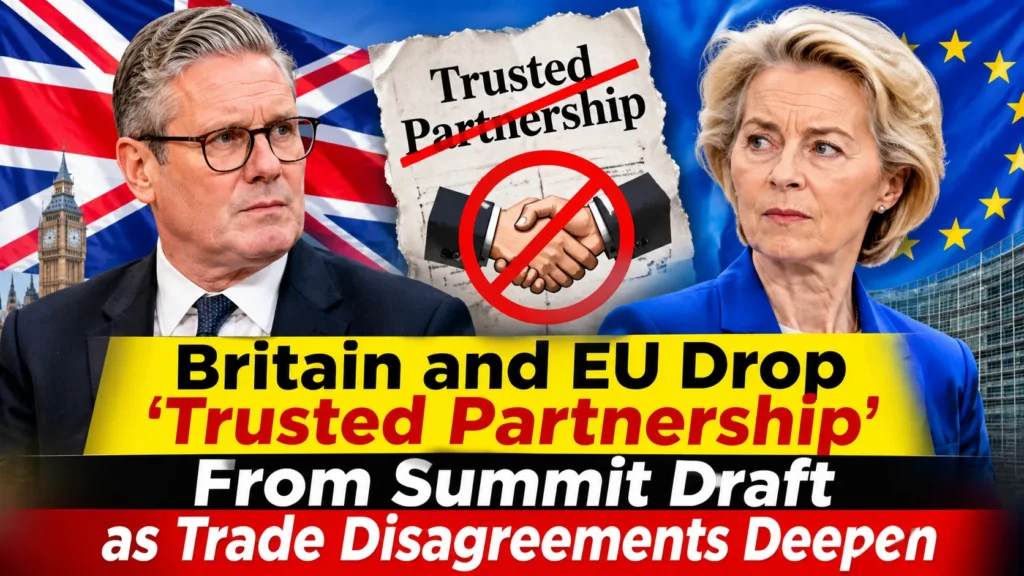

Britain and the European Union have removed the phrase “Trusted partnership” from the latest draft of a joint summit statement, highlighting growing difficulties in negotiations over their future economic relationship. The decision comes just days before an important meeting in Brussels, where both sides hope to make progress on trade, immigration and environmental cooperation.
The change in language reflects disagreements over how closely Britain should follow EU policies, particularly when it comes to protecting European supply chains and supporting the automobile industry.
Why Britain and the EU Dropped ‘Trusted Partnership’
The latest draft of the summit statement no longer includes the proposed commitment to establish a “trusted partnership” between Britain and the European Union.
An earlier version suggested that Britain would align certain policies with EU rules to protect supply chains and strengthen economic security. However, the British government has pushed for softer language that would allow both sides to cooperate without requiring Britain to follow every EU trade policy.
Britain has proposed replacing the previous wording with a commitment to protect supply chains consistently across both markets and prevent potential risks of companies avoiding trade restrictions.
The disagreement suggests that rebuilding relations after Brexit remains complicated, particularly when economic interests and trade policies do not fully match.
British Cars Become a Major Point of Disagreement
One of the biggest challenges involves Britain’s request to have its locally manufactured cars recognised under the EU’s proposed “Made in Europe” rules.
These rules could determine which companies qualify for European public funding, government contracts and financial support schemes.
Britain wants its automobile manufacturers to receive similar treatment to companies based inside the European Union. However, EU officials are considering whether Britain should follow certain European investment and trade protection policies before receiving special status.
A proposal supported by France and Germany suggested that Britain should align its policies with EU restrictions on foreign investment and trade.
This could create pressure on Britain to introduce tariffs on Chinese electric vehicles and restrictions on Chinese hybrid car imports Trusted Partnership.
Such a move could complicate Britain’s relationship with China while affecting its electric vehicle market.
China Trade Creates Another Challenge
The disagreement over Chinese electric vehicles highlights the difficult choices facing Britain.
The European Union has introduced trade measures targeting certain Chinese electric vehicle imports, arguing that unfair competition and subsidies threaten European manufacturers Trusted Partnership.
Britain, however, has different economic priorities. Chinese manufacturers have become increasingly important to its electric vehicle market, offering consumers more affordable options and attracting investment.
Following EU restrictions could therefore create additional costs for British businesses and consumers.
At the same time, failing to reach an agreement with Brussels could leave British carmakers at a disadvantage when competing for European funding and contracts.
Youth Mobility and University Fees Remain Unresolved
The upcoming summit is also expected to address a proposed youth mobility agreement.
The arrangement would allow young British and EU citizens to live, work, study or volunteer in each other’s countries for up to three years Trusted Partnership.
However, negotiations have not settled how many people would be eligible each year.
University tuition fees are another major disagreement. The EU wants its students studying in Britain to receive domestic tuition rates rather than paying international fees, which are typically around three times higher.
The latest draft does not provide a final solution. Instead, both sides aim to resolve the issue within six months.
What to Expect From the Brussels Summit
Despite the disagreements, Britain and the EU are still expected to make progress on several areas during Friday’s summit.
Potential agreements include:
- Reducing barriers to agricultural and food trade.
- Establishing a youth mobility arrangement.
- Linking Britain’s emissions trading system with the EU’s system.
These agreements are part of Britain’s wider effort to rebuild economic and political cooperation with the 27-member European Union without reversing Brexit.
The removal of “trusted partnership” from the draft does not mean negotiations have collapsed. However, it shows that important differences remain between the two sides.
The final summit statement will provide a clearer indication of how far Britain and the EU are willing to compromise.
Frequently Asked Questions
1. Why did Britain and the EU remove ‘trusted partnership’?
The phrase was removed because negotiations over Britain’s alignment with EU trade policies and special access to European funding have proved difficult.
2. What is the EU’s ‘Made in Europe’ policy?
It is a proposed framework intended to give European-made products better access to public funding, government contracts and other support schemes.
3. When is the Britain-EU summit taking place?
The EU-UK summit is scheduled for Friday, November 20, 2026, in Brussels, Belgium.



Pingback: Thanksgiving Dinner Could Cost More in 2026 as Turkey and Grocery Prices Rise Across the US - GyanDe.Com