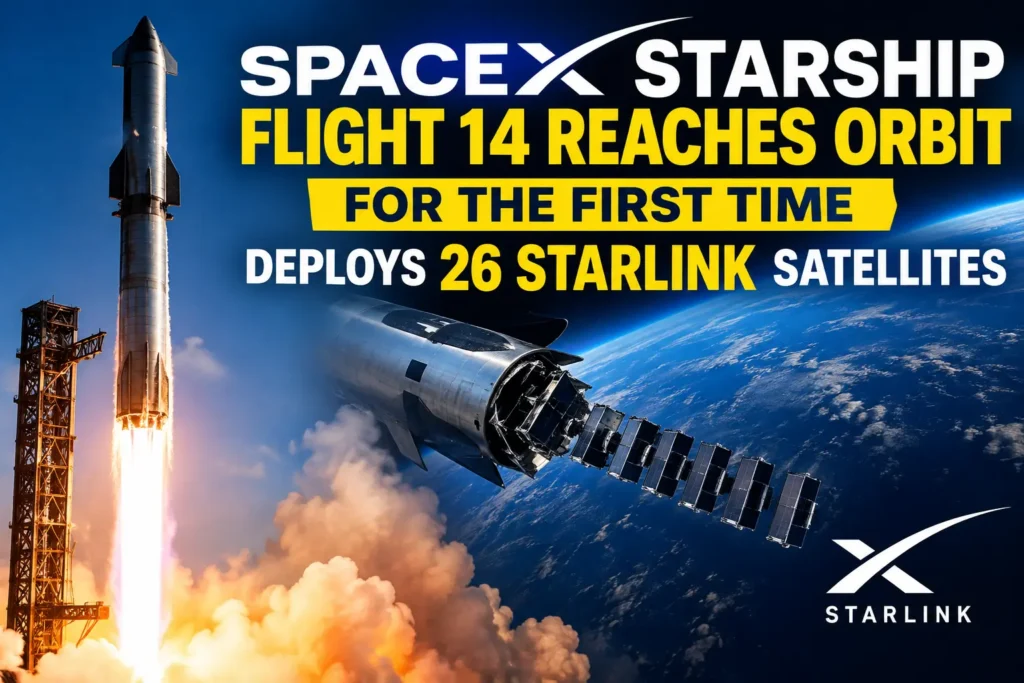

SpaceX’s Starship crossed a major milestone on September 28, 2026, reaching orbit for the first time during its 14th full-scale flight. The uncrewed rocket lifted off from Starbase in South Texas and became the first Starship vehicle to complete an orbital insertion after 13 earlier flights stayed on suborbital trajectories.
The achievement came with a tense moment during the flight. One of Starship’s three main engines shut down earlier than expected after the vehicle reached space. Flight controllers initially questioned whether the planned orbital maneuver could continue, but engineers determined that Starship could still perform the burn. The vehicle then successfully entered orbit.
Flight 14 Carried a Real Payload
This mission was different from earlier Starship tests because it carried operational Starlink V3 satellites rather than demonstration payloads. Starship deployed 26 satellites after reaching orbit, marking the first time the new generation of Starlink spacecraft was placed into the constellation for active service.
| Mission detail | Flight 14 |
|---|---|
| Launch site | Starbase, Texas |
| Payload | 26 Starlink V3 satellites |
| First major milestone | Starship reached orbit |
The satellites were released at an altitude of roughly 269 kilometers. SpaceX said the V3 satellites are designed to provide substantially greater data capacity than its earlier V2 mini satellites, making the flight important not only as a rocket test but also for the future expansion of Starlink.
An Engine Problem Changed the Mission
Flight 14 was originally planned as a nearly 10-hour mission involving several orbits around Earth before a controlled return to the Pacific Ocean. Instead, the mission ended roughly three hours after launch.
The decision followed the unexpected engine shutdown and came after the spacecraft had completed its key orbital and satellite-deployment objectives. Starship later performed a controlled descent and splashdown in the Pacific, ending a flight that was much shorter than planned but still achieved its two central goals: reaching orbit and deploying the satellites.
Super Heavy Also Completed Its Part
Starship did not fly into space alone. The spacecraft was launched on top of the massive Super Heavy booster, which separated after liftoff and performed a boostback maneuver.
The booster returned toward the Gulf of Mexico and completed a controlled splashdown. Some engines experienced problems during its descent, but the booster still carried out the planned return sequence rather than being recovered by the launch tower.
Why Flight 14 Matters for SpaceX
Reaching orbit changes what SpaceX can realistically attempt with Starship. Previous flights provided valuable data on engines, separation, heat shields and controlled reentry, but they did not demonstrate the complete path from launch to orbit with an operational payload.
Starship is being developed as a fully reusable system for launching large numbers of satellites and eventually supporting missions to the Moon and Mars. NASA also plans to use a Starship-derived vehicle as part of its Artemis lunar program.