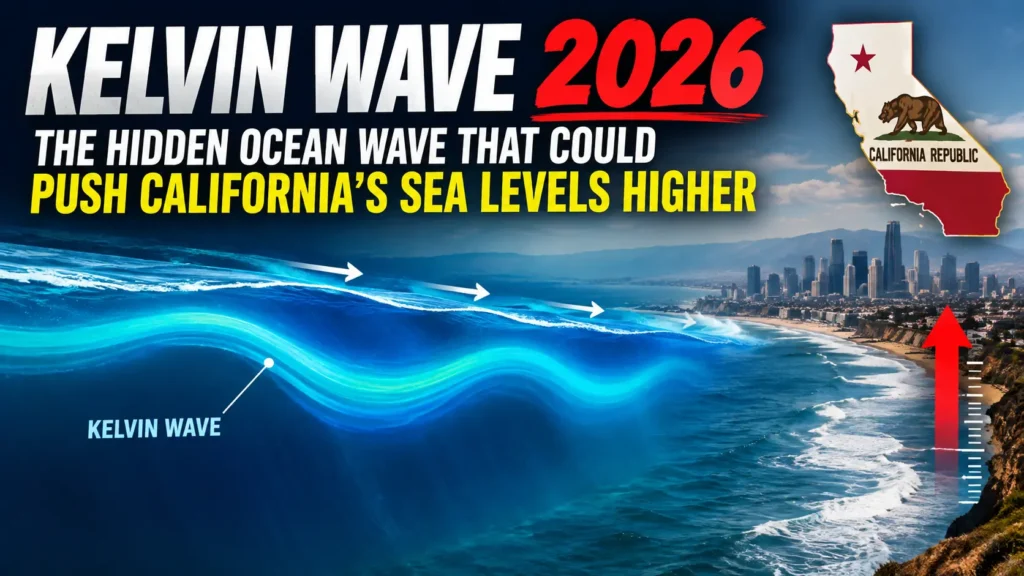

A huge ocean disturbance is moving north along the Pacific coast, putting California’s coastline under fresh pressure as a strong El Niño develops. The phenomenon is known as a coastally trapped Kelvin wave, but despite its dramatic name, it is not a giant wave that will suddenly crash onto beaches.
Scientists are tracking the movement because the Kelvin wave can temporarily raise coastal water levels. Current estimates suggest parts of California could see water levels rise by several inches and, in some locations, potentially approach a foot when combined with tides and storm conditions.
Why the Kelvin Wave Matters in 2026
Kelvin waves are large-scale movements of warm ocean water. In the Pacific, warm water can travel eastward and eventually influence sea levels, ocean temperatures and atmospheric conditions.
NASA satellite observations earlier this year detected a warm Kelvin wave moving from the western Pacific toward South America. By May, sea levels near Peru were more than 15 centimetres above long-term averages, partly reflecting the movement of unusually warm water.
The process is closely linked to El Niño. Warm Kelvin waves can move heat toward the eastern Pacific and help support the development or strengthening of an El Niño event. A Kelvin wave by itself, however, does not guarantee that El Niño will occur.
California Could See Higher Coastal Water
The latest concern is focused on a coastally trapped section of the wave moving northward along the western side of North America.
Researchers tracking its progress have estimated that the disturbance could reach Southern California around early October, although the exact timing remains uncertain. Reports have placed the wave near Mexico before its expected journey toward California and farther north.
The expected rise is particularly important because California has already experienced coastal erosion and flooding in several communities. Higher background water levels can leave less room for incoming storm waves and high tides.
What Residents Should Expect
The Kelvin wave will not look like a tsunami or a massive surf break. People standing on a beach may not notice the wave itself moving through the ocean.
The concern is what happens to the overall water level. A higher ocean baseline can make ordinary coastal flooding more likely, particularly when high tides, large swells or storms arrive at the same time.
| Feature | 2026 Kelvin Wave |
|---|---|
| Type | Coastally trapped ocean wave |
| Main concern | Temporary coastal sea-level rise |
| Expected California impact | Several inches, potentially near 1 foot |
Experts have stressed that the wave is a large-scale ocean process rather than a single wall of water approaching the shore.
Scientists Are Watching the Ocean Closely
Satellite observations and coastal monitoring systems are giving researchers a clearer picture of how these enormous ocean movements develop. Earlier this year, NASA used Sentinel-6 sea-level measurements to track warm water moving across the Pacific.
Researchers are also studying how Kelvin waves interact with other climate patterns. A 2026 study found that oceanic Kelvin waves can interact with the Madden-Julian Oscillation, creating a two-way relationship that may affect tropical weather variability and predictability.
The growing ability to monitor these waves in near real time is especially valuable during a major El Niño year, when even modest changes in coastal water levels can become more significant.