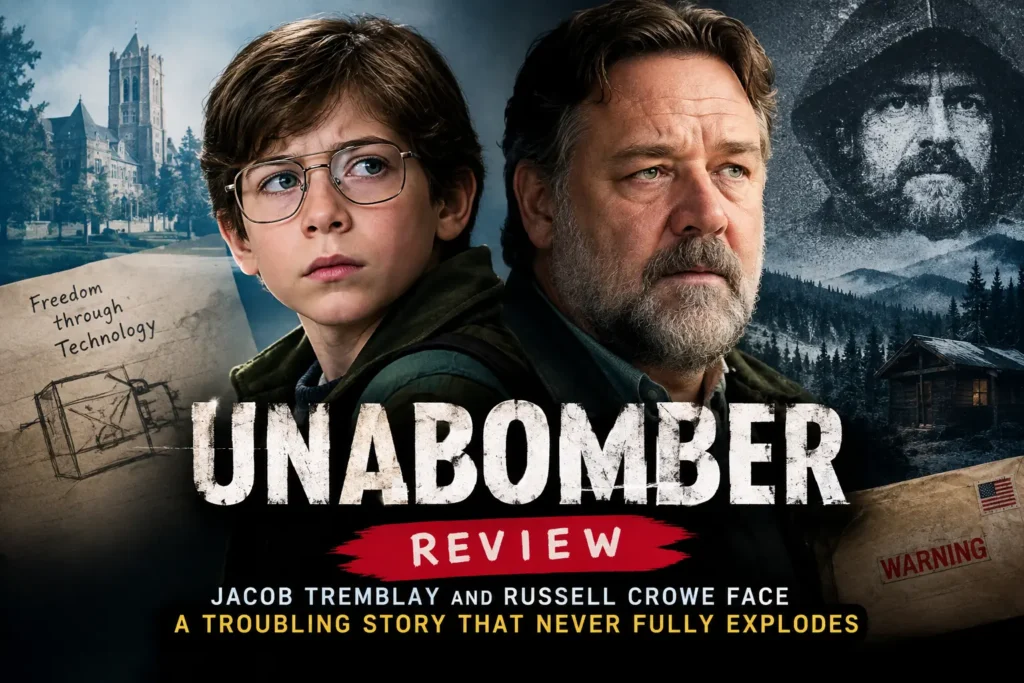

Jacob Tremblay : Netflix’s Unabomber takes on one of the darkest chapters in modern American crime, but its attempt to explain Ted Kaczynski’s path from gifted Harvard student to domestic terrorist never becomes as powerful as the story itself. Directed by Janus Metz and starring Jacob Tremblay, Russell Crowe and Shailene Woodley, the film focuses less on the bombing campaign than on the young man Kaczynski was before he became a household name.
Jacob Tremblay Plays a Young Ted Kaczynski
Tremblay plays Kaczynski at 16, when the future Unabomber arrives at Harvard as a brilliant but socially isolated student. The performance captures his intelligence and discomfort around other people, giving the character an uneasy sense of distance.
The film wants viewers to see how Kaczynski’s experiences affected his worldview. That is a difficult line to walk, because understanding the young man cannot become an excuse for the violence he later committed. Unabomber sometimes struggles to maintain that distinction.
Russell Crowe Brings Darkness to Harvard
Crowe plays Harvard psychology professor Henry Murray, who becomes an important figure in Kaczynski’s college years. The story centers on psychological experiments in which the young student is subjected to intense and humiliating sessions.
Crowe gives Murray an outwardly calm presence that makes the character more unsettling. He can appear supportive one moment and deeply threatening the next. Their scenes together provide some of the film’s strongest tension, even when the screenplay pushes the relationship too heavily as an explanation for Kaczynski’s later actions.
The Film Jumps Between Two Timelines
Unabomber moves between the late 1950s and the 1990s. One storyline follows Kaczynski at Harvard, while the other follows an FBI investigation trying to identify the man behind the bombing campaign.
The structure gives the film a built-in mystery, but there is a problem: audiences already know who Kaczynski is and how the story ends. The FBI material therefore has less suspense than a conventional crime thriller. The more interesting question is why the filmmakers believe his Harvard years matter so much.
A Real History With a Complicated Record
Kaczynski carried out a nearly two-decade bombing campaign targeting people connected to technology, science, business and academia. Three people were killed and 23 were injured before his arrest in 1996.
The film draws attention to his time at Harvard and the psychological study led by Murray. That history is real, but the movie turns it into a much cleaner chain of cause and effect than real life allows. Kaczynski himself later disputed the idea that the experiment was responsible for his transformation.
That tension matters because Unabomber is at its weakest when it seems too certain about what created a person whose beliefs and crimes were far more complicated.
Strong Performances, Uneven Storytelling
Tremblay and Crowe are clearly the main reason to watch. Their performances give the film moments of emotional intensity that the writing does not always provide.
The trouble is that the movie often explains its ideas instead of allowing them to develop naturally. The 1990s investigation can feel routine, while the Harvard sections sometimes lean toward psychological thriller clichés.
Still, the subject remains compelling. Kaczynski’s story raises uncomfortable questions about isolation, intellectual obsession, technology and radicalization. The film simply does not explore those questions with enough depth.
FAQ
Is Unabomber based on a true story?
Yes. The film is based on the life of Ted Kaczynski, who carried out a mail-bombing campaign in the United States over nearly two decades.
Who plays Ted Kaczynski in Unabomber?
Jacob Tremblay plays the young Ted Kaczynski. Russell Crowe plays Harvard psychology professor Henry Murray, while Shailene Woodley plays FBI agent Joanne Miller.
Is Unabomber worth watching?
The film may appeal to viewers interested in true crime, Ted Kaczynski’s early life and psychological thrillers. Its strongest element is the work of Tremblay and Crowe, while its divided timeline and simplified explanation of Kaczynski’s radicalization make the drama less convincing.