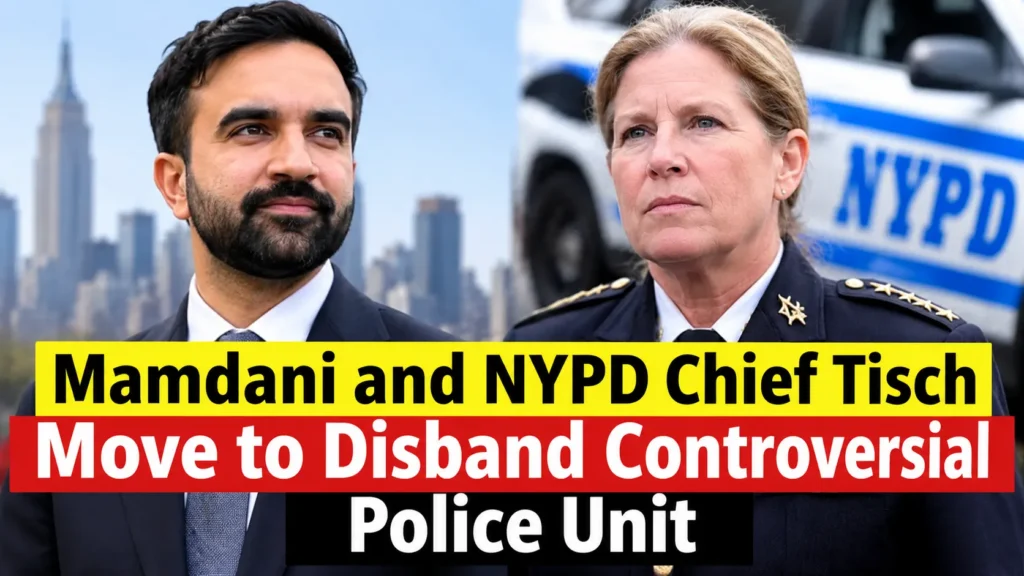

New York City is preparing for a major change in how its police department handles protests and public demonstrations. Mayor Zohran Mamdani and NYPD Commissioner Jessica Tisch have agreed to disband the department’s controversial Strategic Response Group (SRG), announcing a new approach that puts communication and de-escalation at the center of protest policing.
The announcement, made Monday, November 16, follows months of discussions between the mayor and police leadership. It also fulfills one of Mamdani’s major campaign promises, while raising important questions about public safety, counterterrorism operations and the future of policing in America’s largest city.
Mamdani Announces the End of the NYPD’s Strategic Response Group
During an exclusive joint interview with ABC7 Eyewitness News, Mamdani described the decision as a significant change in the city’s approach to demonstrations.
The Strategic Response Group was created to respond quickly to major incidents, including counterterrorism threats, serious crimes and large public gatherings. However, its involvement in protest policing has attracted criticism from civil rights advocates and demonstrators who have questioned the unit’s crowd-control tactics.
Mamdani believes counterterrorism and peaceful protest management should be handled separately. His administration wants demonstrations to be met with communication rather than an unnecessarily aggressive police response.
Disbanding the SRG was a central promise during his mayoral campaign, and Monday’s announcement represents a major step toward delivering on that commitment.
Jessica Tisch Says Public Safety Will Not Be Compromised
Police Commissioner Jessica Tisch has supported the restructuring, making clear that the department’s ability to protect New Yorkers will remain a priority.
The SRG currently has approximately 500 highly trained uniformed officers. Rather than eliminating those positions, the NYPD will redistribute officers and responsibilities across different units.
Many officers will move into the department’s Counterterrorism Bureau, while other personnel will support patrol operations and crowd management.
Tisch rejected the suggestion that the changes represent a compromise on security. She argued that separating responsibilities will strengthen the department’s organization and allow officers to focus on their specific assignments.
Her support is particularly important because the proposal changes the structure of a specialized police unit without reducing the department’s overall workforce. Mamdani
New Civilian Team Will Focus on Protest Communication
One of the biggest parts of the new plan is the creation of a civilian-led Community Dialogue and De-escalation Division.
The division will operate within the Mayor’s Office of Community Safety. Its members will work with protest organizers before and during demonstrations, helping prevent misunderstandings and reduce tensions.
The civilian team will not carry weapons or have arrest powers.
The NYPD will also establish a First Amendment Support Team, known as FAST. The specialized team will include 30 uniformed officers trained in communication and de-escalation.
Together, these teams will help coordinate protest responses while protecting the constitutional rights of people participating in peaceful demonstrations.
New Rules Will Restrict Controversial Police Tactics
The restructuring also introduces restrictions on several crowd-control methods that have attracted criticism.
Under the announced reforms, officers will face new rules during First Amendment activities, including:
- Kettling, which involves surrounding crowds and restricting their movement, will be prohibited.
- Tear gas and long guns will not be permitted for protest management.
- Pepper spray will not be used as a general crowd-control tool.
- Long-range acoustic devices will be limited to 90 decibels.
- Officers will face restrictions on using bicycles as weapons.
These measures aim to reduce confrontations between police and demonstrators while maintaining the department’s ability to respond to genuine safety threats.
What Happens to Counterterrorism and Crowd Control?
The SRG’s counterterrorism responsibilities, including deployments involving heavy weapons at critical infrastructure, will move to the NYPD’s existing Intelligence and Counterterrorism Bureau.
Meanwhile, a new Patrol Support Division will take responsibility for specialized crowd-management assistance.
Its officers will receive additional training and spend most of their time supporting regular patrol operations. They can also assist with major public events, missing-person searches and emergencies.
The changes will begin rolling out in January, with the Strategic Response Group scheduled to be dissolved in spring 2027.
The administration says the restructuring will happen without additional spending or changes to the NYPD’s total headcount.
Frequently Asked Questions (FAQs)
1. Why is Mayor Mamdani disbanding the NYPD’s Strategic Response Group?
Mamdani wants to separate counterterrorism operations from protest policing and introduce a more communication-focused approach to handling demonstrations.
2. Will the NYPD lose 500 officers after the SRG is disbanded?
No. The approximately 500 officers will be reassigned to other NYPD units, including counterterrorism and patrol operations.
3. When will the Strategic Response Group officially close?
The restructuring is expected to begin in January 2027, with the SRG scheduled to be dissolved in spring 2027.



Pingback: Slow Horses Renewed for Seasons 9 and 10, but Jack Lowden’s Future as River Cartwright Remains Uncertain - GyanDe.Com