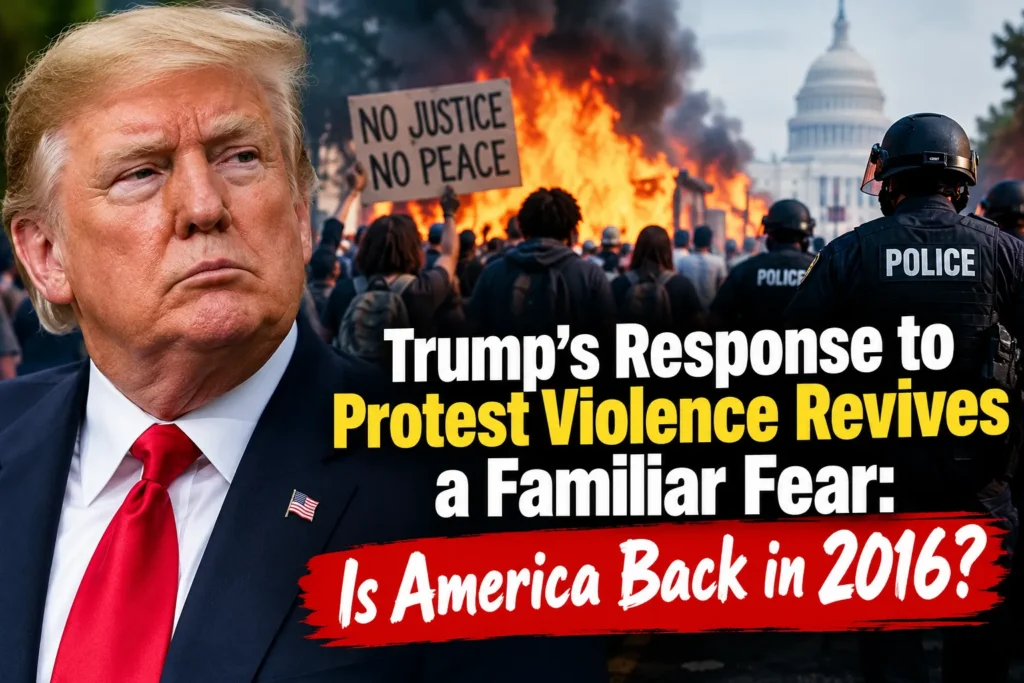

Donald Trump’s celebration of violence against protesters has revived memories of the bitter political climate that helped define his rise in 2016. For critics, the rhetoric is a reminder of a period when confrontations at political rallies, attacks on opponents and questions about the limits of presidential power became central to the national debate.
The issue goes beyond one statement or one political event. It raises a bigger question about how a president talks about dissent, how supporters interpret that language and what happens when political disagreement turns into physical confrontation.
What Happened at the South Carolina Rally? Trump’s
At an October 2026 rally in South Carolina, Trump reportedly reacted enthusiastically to a physical confrontation involving a protester and another person in the audience. The incident unfolded during a politically charged event where demonstrators interrupted his remarks. Trump reportedly praised the person who threw punches, drawing fresh attention to his attitude toward political dissent.
The confrontation has renewed debate about whether Trump’s language encourages supporters to view protesters as enemies rather than fellow citizens exercising their rights. His critics argue that celebrating physical aggression from a political stage risks making violence seem acceptable when directed at people who disagree with him.
Why the Comparisons With 2016 Are Returning
Trump’s first presidential campaign was marked by heated rallies, confrontations with demonstrators and repeated controversies over his comments about physical force. In February 2016, he told supporters at an Iowa rally to knock down someone preparing to throw a tomato and suggested he would cover their legal fees.
During another campaign appearance, Trump said he wanted to punch a heckler in the face. In March that year, a protester being escorted out of a rally in North Carolina was punched by a Trump supporter. The incident intensified questions about the atmosphere surrounding the candidate’s events.
Those episodes became defining moments of the 2016 campaign. For people who remember them, Trump’s reported reaction to the latest confrontation suggests that the tensions surrounding his political style have not disappeared.
How Trump’s Rhetoric Shapes the Political Debate
Political leaders have considerable influence over how supporters interpret conflict. A forceful response to heckling can energize a crowd, but celebrating an assault can also blur the line between verbal confrontation and physical punishment.
Trump’s supporters may see his reactions as humor, defiance or frustration with demonstrators who interrupt political speeches. Critics see something more troubling: a president appearing to reward aggression against people who challenge him.
The distinction matters because peaceful protest is a protected part of American democratic life. People can disagree strongly with a demonstrator’s message without accepting violence as a response. Equally, protesters remain responsible for their own conduct, and violence by demonstrators should not be excused.
The central issue is whether political leaders apply the same standard to supporters and opponents. Condemning violence consistently, regardless of who commits it, is essential to maintaining public trust.
What This Means for American Democracy
The latest controversy arrives as political divisions continue to shape public debate in the United States. Campaign events can become flashpoints when anger, partisan loyalty and confrontational messaging combine.
The consequences extend beyond a single rally. When political violence is treated as entertainment, people may become less sensitive to the real harm caused by physical attacks. It can also deepen distrust between Americans who already view one another through opposing political identities.
The response from elected officials, political organizations and law enforcement will help determine how the incident is understood. Video footage, eyewitness accounts and official statements are important for establishing precisely what happened and whether anyone faces legal consequences.
The comparison with 2016 is therefore about more than Trump’s familiar political style. It is about whether the country has learned anything from years of increasingly hostile political confrontations.
Why the Reaction Matters Beyond Trump’s Supporters
The controversy also presents a challenge for Republicans who want to defend free speech while maintaining public order. Supporting a candidate does not require defending every statement or reaction, just as opposing a president does not justify attacking his supporters.
Americans have the right to protest, criticize public officials and express unpopular opinions peacefully. Political leaders have the responsibility to respect those rights, even when demonstrations interrupt carefully planned events.
Trump’s reaction may energize some supporters, but it also gives opponents another reason to question his approach to political disagreement. Whether the incident has a lasting political impact will depend on the evidence, the public response and what happens next.
The larger concern remains straightforward: when leaders celebrate violence against people who disagree with them, the boundaries of acceptable political behavior become harder to defend.
FAQ
1. Why are Trump’s comments being compared with the 2016 campaign?
His reported reaction to violence against a protester recalls his 2016 campaign, when comments about punching hecklers and physically confronting demonstrators triggered widespread criticism.
2. Is peaceful protest protected in the United States?
Yes. The First Amendment protects peaceful protest and political expression, although reasonable legal restrictions can apply in certain circumstances. Violence and other unlawful conduct are not automatically protected.
3. Could this controversy affect Trump’s political support?
It could influence public opinion, particularly among voters concerned about political violence. However, its actual electoral impact will depend on how voters interpret the incident and whether it becomes a sustained issue in the political debate.